

Africa doesn't need democracy
how 2026 can be a new chapter for borrowed institutions

Democracy, in any substantive sense, does not exist in Africa. With the exceptions of South Africa, Botswana, the Seychelles, and Cabo Verde (and to a lesser extent Mauritius, Senegal, Ghana and Nigeria), few regimes on the continent exhibit even the basic features of a state governed by the rule of law. What is in crisis are the institutional arrangements inherited from the colonial era which, in the 1990s, got a fresh coat of paint but nothing more. The structure beneath remains rotten.
Following the waves of protest that led to national conferences and constitutional revisions, many states appeared to turn their backs on military rule and one-party systems, seemingly converting to the dogmas of the market economy. Yet they took great care to avoid adhering to the fundamental principles of the rule of law. In place of substantive democracy, they settled for an “administrative multi-partyism,” whose sole function was to drape a new mask over the old trappings of the one-party state. The mask changed. The face beneath it did not.
In many communist-led countries, the one-party system was the ultimate political form of totalitarianism, used by elites to regiment society. In Africa, however, the immediate source of both military and one-party regimes is found in colonialism. A profound driver of colonial power was the self-hatred it systematically instilled in the indigenous population. This was not accidental. It was deliberate policy. The granting of independence did not neutralize this poison. On the contrary, African ruling classes quickly seized upon this dark resource to pursue, for their own benefit, the process of “auto-colonization” (the continuation of colonial governance by African elites themselves) first inaugurated via the system of local chieftaincies during foreign occupation. It is this process that continues today. Administrative multi-partyism, as a derivative of the one-party state, does not break with the logic of self-hatred necessary for auto-colonization.
The contemporary African crisis has nothing to do with democracy in its substantive form. What has broken down is the paradigm of auto-colonization itself. What is no longer tolerable is that rulers continue to administer their citizens as if they were colonial subjects, and their countries as if they were occupied territories. The fiction has worn thin.
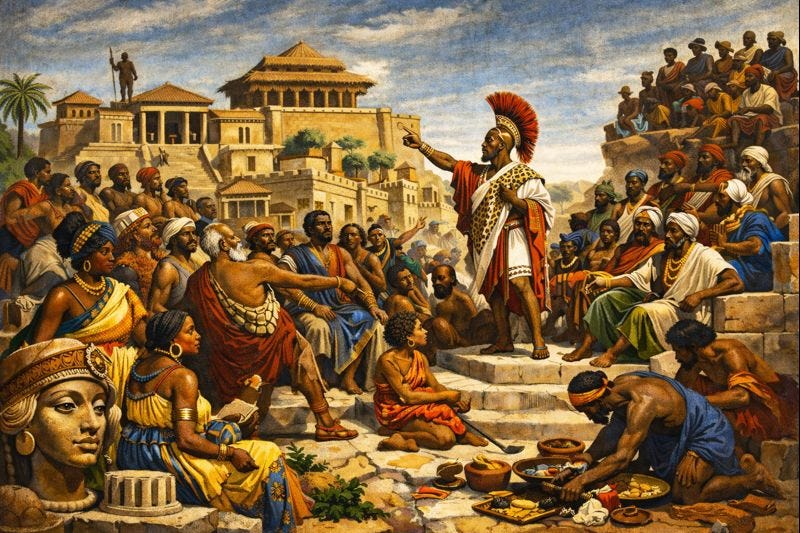
But here lies a deeper problem that precedes even administrative multi-partyism: the wholesale importation of Western governance models onto societies with their own rich traditions of political organization. When the French burned Timbuktu’s manuscripts in 1893, they were not just destroying books. They were committing what scholars now call epistemicide—the systematic erasure of knowledge systems. The colonial project required Africa to have “no real written history,” no functional political structures, no intellectual traditions worth preserving. Only then could European models be presented as civilization itself rather than one option among many.
This erasure created a peculiar bind. Post-independence African states inherited constitutions, parliaments, and bureaucracies modeled on Westminster or the Élysée Palace. But these institutions were grafted onto societies that had, for centuries, developed their own mechanisms for consensus-building, conflict resolution, and resource distribution. The Sokoto Caliphate had sophisticated administrative systems. The Kingdom of Kongo had complex diplomatic protocols. Countless societies across the continent had evolved forms of governance that balanced centralized authority with local autonomy, that incorporated multiple stakeholders, that distributed power across kinship networks and age-grade associations. These were not primitive approximations of Western democracy. They were functional political systems adapted to specific ecological, demographic, and cultural contexts.
Colonial rule didn’t just interrupt these systems. It criminalized them. Indigenous governance structures were dismantled, their authority figures co-opted or eliminated, their legitimacy systematically undermined. What replaced them were extractive administrative apparatuses designed not for the welfare of governed populations but for the efficient exploitation of resources. Independence changed the faces at the top. It did not change the logic of the institutions themselves.
So when we speak of a “democratic crisis” in Africa, we are speaking about the failure of institutions that were never designed for African societies in the first place. We are measuring African governance against a yardstick that assumes the universal applicability of Western political forms. But what if the crisis is not that Africa has failed at Western democracy, but that Western democracy has failed Africa? What if the path forward requires not better implementation of borrowed institutions, but the reconstruction of governance systems rooted in Africa’s own intellectual and political traditions?
This is not a romantic call to return to some idealized pre-colonial past. That past is irrecoverable, and much of it would be unsuitable for contemporary conditions in any case. But it is a call to recognize that Africa’s political future need not be a pale imitation of Western models. The continent’s tradition of what might be called “primordial pluralism”—the constant exposure to diverse ways of organizing society, the absence of a single monolithic dogma—created societies comfortable with difference, adept at negotiation, skilled at synthesizing disparate elements into new forms. This is not a weakness. It is a resource.
The challenge is not to import more Western expertise, more technical assistance, more conditional aid tied to “good governance” metrics defined in Washington or Brussels. The challenge is to create space for African thinkers, activists, and citizens to imagine and build political systems that draw on the continent’s own deep wells of knowledge. Systems that might look nothing like parliamentary democracy but could prove far more effective at delivering security, prosperity, and justice. Systems that recognize that legitimacy comes not from mimicking foreign models but from resonating with the lived experiences and historical memories of the people they govern.
Until African states undertake this work of political imagination, they will remain trapped in a double bind: condemned for failing at democracy while prohibited from attempting anything else.
This form of government, practiced for over a century, has proved incapable of addressing the three great historic crises stalling the continent’s development:
The crisis of wealth production: African states have failed to create the conditions for wealth production necessary to meet the vital needs of their people. The machinery is broken or was never built in the first place.
The crisis of redistribution: What little wealth does circulate is hoarded by a shrinking class of predators whose interests are diametrically opposed to those of the masses they command. The gap widens daily.
The crisis of citizen representation: The widening chasm separating the social body, the electorate and the political class now resembles a canyon. Those who govern and those who are governed inhabit different realities entirely.
The administrative multi-party model has only made these worse. It relies on extracting natural resources, an economy built on destroying the environment and habitats. This increasingly resembles a "war economy," where the decisive struggle is over the means of predation rather than production. Everywhere, this model demands heightened violence to ensure profit.
In the tradition of colonial command, the goal of most regimes is to perpetuate a society of subjects rather than a community of citizens. This is why they strive to prevent the emergence of strong civil societies or independent authorities. They wish to exercise power without accountability. Politics has become a zero-sum game: those who lose, lose everything, facing prison or exile; those who win, gain total access to the sources of predation. There is no middle ground. No compromise. No shared governance. Only winners and losers.
The violence is not a bug in the system. It is the system.
We are entering a dark period in human history. Across the globe, including in the West, we are witnessing the retreat and hollowing out of democracy, the emasculation of multilateral institutions, and the destruction of international solidarity. This is an era where force and power are reduced to their simplest expression: the capacity to seize. Might makes right. The strong do what they can. The weak suffer what they must.
In Africa, this “spirit of the times” risks a formidable ransacking of natural wealth and the destruction of human life, as seen today in Sudan, eastern DRC, and the Sahel. The plunder is not coming. It is already here. This is all the more reason to support civil societies and the rising competence of those inventing new ways of living together. It is essential to create new social coalitions involving women, youth, intellectuals and activists. This is the great battle of ideas currently under way in Africa: it pits “neo-sovereignists” who believe in the power of brute force, against social coalitions aspiring to substantive democracy, betting not on brutality but on the collective intelligence of Africans. One side offers guns. The other offers ideas. History will judge which proved more durable.
Mo Ibrahim and the Multipolar World Order
In a year of turmoil, tariffs and escalating conflicts, how should African governments, businesses and activists negotiate the new geopolitics, the decline of the West and the surge of the middle powers? Optimists and bolder business types cite the Chinese ideogram (wēi + jī) that means both risk and opportunity. It sounds good in PowerPoint presentations. But does it hold up under scrutiny?
A wave of speculative interest in Africa’s markets and resources on show at commercial conferences on the continent provides a measure. Investors are circling. Capital is flowing. The rhetoric is bullish. But such levels of investment, unevenly distributed and focusing relentlessly on extractive resource projects, will not generate the transformative growth the continent needs, according to the telecoms pioneer Mo Ibrahim. For 20 years, his foundation has been cajoling and encouraging politicians and international officials to raise governance standards in Africa and develop a more coherent trade policy across the continent. He has seen enough conferences and enough promises to know the difference between real commitment and performative interest.
Get Up, Stand Up for Our Rights
Does the geopolitical chaos add up to a liberation moment for Africa? “Not at all,” says Ibrahim. His answer is immediate. No hesitation. “What kind of liberation are we talking about? We have half the countries in Africa under military coups and dictatorships. We have more internal conflicts than at any point in our lives. So we’re in bad shape.”
In principle, a multipolar international system should be good for Africa. More players mean more options. More competition should mean better terms. But policy makers have to use the space to select trading partners more carefully and negotiate terms more scrupulously, says Ibrahim. Then African governments can free themselves from the constraints of one-size-fits-all Western conditionality. The opportunity exists. Whether it will be seized is another question entirely.
At his foundation’s governance weekend in Marrakesh in June, Ibrahim proselytized for African self-reliance in the new world disorder: “We must rely on our resources... get organized and get our house in order. We are a very rich continent but a very poor people. We are mismanaging our countries, our resources, our people.” The message was blunt. Uncomfortable. True.
Part of that is for African states to have a coordinated policy towards other regions. There’s little joined-up thinking among governments towards the two regions of the world investing the most in the continent. “China has an Africa policy, but Africa has no China policy,” says Ibrahim. “The Gulf States may not coordinate that well, but I’m sure that Saudi Arabia and the UAE sit together at some point and say ‘this Sudan issue looks X, Y, Z – let’s agree to disagree’.” African states need to coordinate more than ever at a time when the multilateral systems (the UN, IMF and World Bank) are starved of cash and crumbling. The architecture of the post-war order is collapsing. What replaces it is unclear.
“Look where we are moving,” warns Ibrahim. “Strong states coercing the weak. You see it everywhere. International law is breaking up. Now it’s the rule of the jungle, and we have to be careful.” The law of the jungle favors predators. Africa has been prey before.
Demise of Aid from the US
He is phlegmatic when it comes to shrinking European and disappearing US aid budgets. Without minimizing the wide-scale effects of aid cuts on humanitarian aid in war zones, research by the Ibrahim Foundation found the losses of revenue for development projects fell short of catastrophic. The numbers tell a different story than the panic suggests.
Foreign aid to African economies in 2023 amounted to $73.6bn, less than 10% of the continent’s combined revenue when compared to:
Remittances: $90.8bn
Foreign direct investment: $97.1bn
Tax revenues: $479.7bn
The US aid cuts prompted more shocked coverage and condemnation because of their peremptory implementation, but were mirrored by falling European aid budgets. On the day of his inauguration (20 January) for a second presidential term, Donald Trump froze all US Agency for International Development (USAID) programmes pending a government review. By 7 May, only 891 (14%) of the 6,526 operating USAID programmes remained, costing $69bn down from $120bn on 20 January. The cuts were swift. Brutal. Comprehensive.
In 2023, USAID allocated a fifth of its funding to Africa. The Washington-based Centre for Global Development reported that for 42 African countries (out of 44 for which data is available), the 2025 US aid cuts amounted to less than 1% of their gross national income. The sky did not fall. But neither did the aid dependency disappear.
Ibrahim says there is no time for nostalgia. The best response is to accept changes (prompted by weakened economies, Western nationalism and swelling defense budgets) and mobilize domestic resources. The Foundation’s report on ‘Financing the Africa We Want’ estimates that illicit financial flows amount to $90bn a year; most are linked to trade misinvoicing in extractive commodities, over half to gold trading. Ending the losses requires high-level cooperation between African governments and recipient jurisdictions. The money exists. It is simply flowing in the wrong direction.
“[Africa] has $130bn in sovereign wealth funds and $220bn in pension funds, which can be leveraged for investments,” Ibrahim notes. The capital is there. The question is whether the political will exists to deploy it effectively.
Ibrahim is enthused by the wave of Gen Z activists across the continent but wants that energy channeled into politics to improve living conditions. “You shouldn’t be surprised when you see people gather and respond to government failures. We expect more of these movements. What we hope is that they will have a leadership which knows where to take this,” he says. “The situation is bleak. But I never lose hope because the younger generation is coming with more understanding and is better equipped for the future.” Energy without direction is just noise. Direction without energy achieves nothing. The challenge is bringing the two together.
Young Activists Stand Up to the Challenge
In some ways, says Ibrahim, political activism is harder than during the anti-colonial struggle. “The targets are moving, more diffuse, it’s more complex. Before, the enemy was clear. Now some are wearing suits, some are wearing military uniforms. We need leadership who can articulate a vision of the future. It’s not enough to rebel.” Rebellion is easy. Building is hard. Sustaining is harder still.
Ibrahim’s commitment to bring young activists together was evident from the attendees at his Marrakesh conference, including Bobi Wine, leader of Uganda’s National Unity Platform party and candidate in the presidential election in January. “We’re inviting them not just to listen to us talking or for us to listen to them. They have to connect with each other. We need to build this understanding and support across the continent.” Networks matter. Solidarity matters. Isolation kills movements.
The Ibrahim Foundation was one of the first international organizations, ahead of the African Union and Southern African Development Community, to speak against the electoral failings in Tanzania and the brutal repression meted out to protesters by President Samia Suluhu Hassan’s government. Silence in the face of repression is complicity. Ibrahim refuses to be complicit.
Widening the aperture, looking at the currents in global politics and the obstacles to economic development, is testing Ibrahim’s innate optimism at what can be achieved. Progress has not been as fast as was required over the past 20 or 30 years. “We’re not doing anything about climate [change]. The finances to fix those things (to get people basic power, education, health services) is diminishing. The pessimists look like they’re winning.” But winning and being right are not the same thing. Ibrahim is betting on the optimists.
If Africa can build its institutions, such as the AU and African Continental Free Trade Area, resolve its conflicts and raise its economic tempo, the continent will thrive in this multipolar era as global power shifts from the West to the East, Ibrahim says. The ingredients for success exist. The recipe is known. What remains unclear is whether anyone will follow it.